
What is an IPO (Initial Public Offering)? The Beginner’s Guide
Every few weeks, the news explodes with hype about a new company entering the stock market. But what exactly is an IPO? We break down the jargon, the hidden risks, and how you can safely participate without getting burned.
1. The Bakery Analogy: What Exactly is an IPO?
To understand an IPO, let’s completely ignore the stock market for a minute. Let’s talk about a local business.
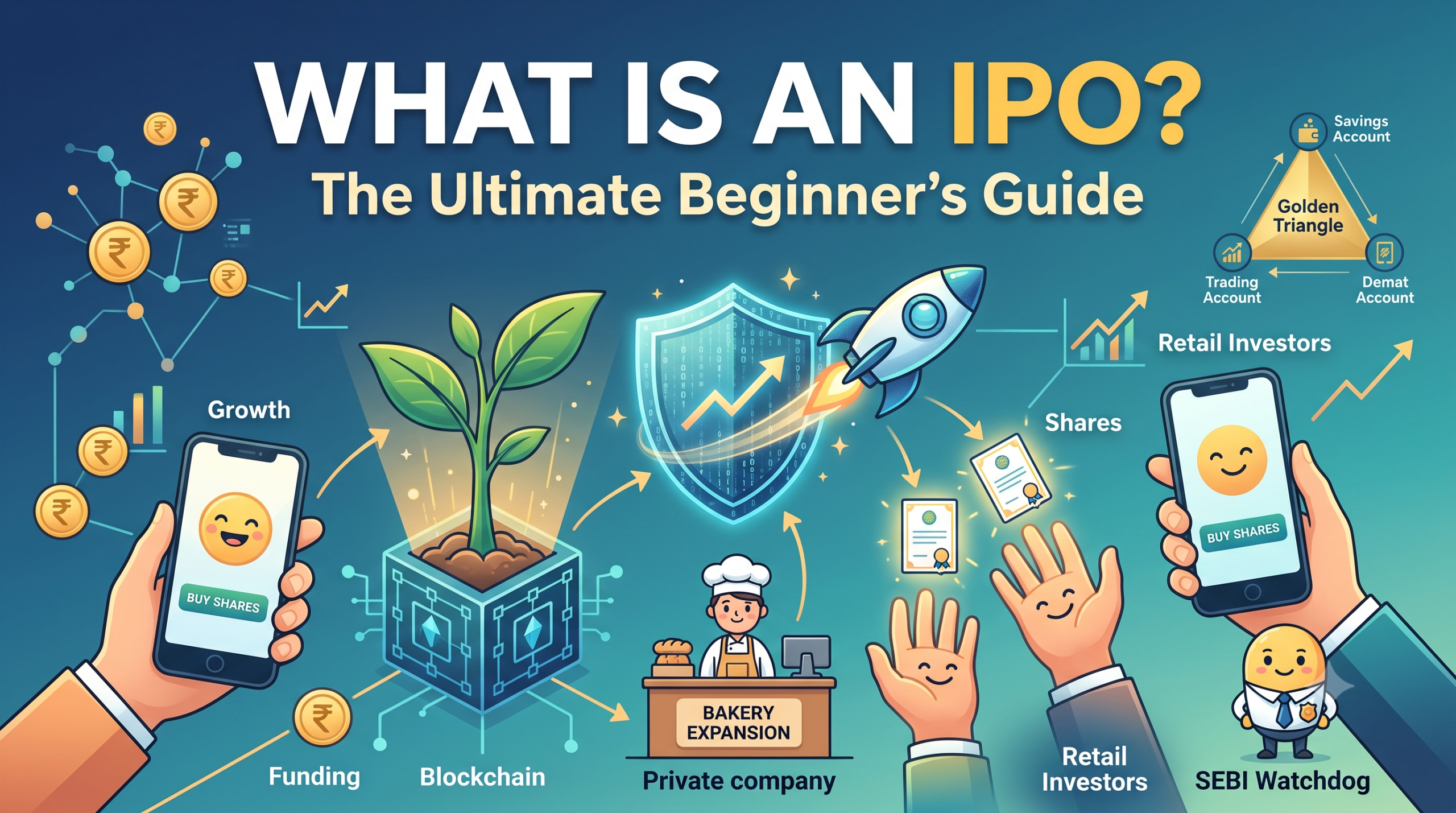
Imagine your friend starts a small bakery. She makes the best chocolate cakes in the city. After five years, she has three highly successful shops. Now, she has a grand vision: she wants to open 100 new bakeries all across India. But opening 100 bakeries costs ₹50 Crores.
Where does she get that kind of money? She could go to a bank, but a ₹50 Crore loan will come with crushing monthly interest payments. Instead, she decides to do something brilliant: she divides her company into millions of tiny, equal pieces (shares). She keeps 70% of the pieces for herself to maintain control, and she sells the remaining 30% of the pieces to regular people like you and me.
We give her our cash, and she gives us a piece of her company. That exact moment when a private company steps out and sells its shares to the public for the very first time is called an Initial Public Offering (IPO).
🌍 Real-World Example: Rohan the Proud Co-Owner
The Person: Rohan, age 26, an IT professional from Pune.
The Before: A famous food delivery app that Rohan uses every weekend announced it was doing an IPO. Rohan loved the app but was confused about why they needed his money.
The Action: Rohan read that the company needed ₹5,000 Crores to expand into smaller tier-3 cities and upgrade their delivery technology. He applied for the IPO and got allotted ₹15,000 worth of shares.
The After: With Rohan’s money (and the money of a million other people), the company expanded successfully. Because the company grew bigger and more profitable, the value of Rohan’s ₹15,000 investment grew to ₹25,000 in two years. He literally profited from their success.
2. IPO Jargon Buster: Words You Need to Know
The stock market is full of confusing words designed to make things sound complicated. When you open a news website to read about an upcoming IPO, you will see these terms. Let’s translate them into plain English.
1. Promoters
These are the original founders and owners of the company. In our bakery example, your friend who baked the cakes is the “Promoter.” When an IPO happens, promoters are selling a portion of their ownership to you.
2. Retail Investors (That’s You!)
In India, SEBI (the stock market police) divides buyers into categories. Normal, everyday people who apply for IPO shares worth less than ₹2 Lakhs are called Retail Investors. A specific chunk (usually 35%) of the IPO is reserved exclusively for us.
3. Price Band
A company usually doesn’t say, “One share is exactly ₹100.” They give a range, like ₹95 to ₹100. This is the Price Band. Pro Tip: Always bid at the “Cut-off Price” (the highest number in the band) to ensure your application is accepted.
4. Lot Size
You cannot buy just 1 single share in an IPO. You have to buy them in bundles. Think of it like buying eggs; you can’t buy 1 egg, you have to buy a carton of 12. If a company sets their “Lot Size” at 50 shares, you must buy 50, 100, or 150 shares. You cannot buy 51.
3. Why Didn’t I Get Any Shares? (The Lottery System)
One of the most frustrating things for a beginner is applying for a famous IPO, locking their money, and then checking their status a week later only to see: “Zero Shares Allotted.”
How does this happen? It happens because of Oversubscription.
Imagine a highly anticipated tech company decides to sell 1 Lakh shares to the public. But because the company is so popular, 10 Lakh people apply to buy those shares. There simply aren’t enough shares for everyone. When this happens, SEBI (the stock market regulator) steps in and forces the company to use a blind, computerized lottery system. It is purely based on luck.
🌍 Real-World Example: Sneha’s Lottery Frustration
The Person: Sneha, age 29, a teacher in Hyderabad.
The Before: A massive electric vehicle company announced its IPO. Everyone on YouTube and TV was talking about it. Sneha really wanted in. To guarantee she got shares, she applied for 5 Lots (costing her ₹75,000).
The Crisis: The IPO was “oversubscribed 50x” (meaning there was 50 times more demand than actual shares available). When the allotment day arrived, Sneha got zero shares. Meanwhile, her brother, who only applied for 1 single Lot (₹15,000), won the lottery and got allotted shares.
The Lesson: Sneha learned that in wildly popular IPOs, applying for maximum lots does not increase your chances of winning. The system treats every application equally. To increase your odds in a family, it is better to apply for 1 Lot each from three different Demat accounts (like yours, your spouse’s, and your parent’s) rather than 3 Lots from one account.
4. What is GMP (Grey Market Premium)? The Hype Trap
If you spend 5 minutes reading about IPOs, you will hear the term GMP. It stands for Grey Market Premium.
Before an IPO officially “lists” (starts trading on the NSE/BSE app), there is a waiting period of about a week. During this week, big investors and brokers trade unofficially in a hidden market called the “Grey Market.” If the official IPO price is ₹100, but people are so desperate for shares that they are willing to pay ₹140 unofficially, the GMP is ₹40.
Many beginners use GMP as a cheat code. They think, “If the GMP is high today, I will apply, and I am guaranteed to make a 40% profit on listing day.” This is a very dangerous assumption.
🌍 Real-World Example: Vikram’s GMP Disaster
The Person: Vikram, age 32, a new investor looking for a quick profit.
The Before: A major payment app was launching its IPO at ₹2,150 per share. Blogs were screaming that the GMP was ₹400 positive. Vikram didn’t understand the company’s business model or look at their massive debts; he just saw the GMP. He applied for ₹1.5 Lakhs worth of shares and won the allotment. He planned to sell them on Day 1, grab his ₹30,000 “guaranteed” GMP profit, and walk away.
The Crisis: Global markets crashed the night before the listing. The Grey Market panicked. On the actual listing morning, the share didn’t list at a premium. It listed at a 9% discount (₹1,950), and over the next month, it crashed to ₹1,200. Vikram was trapped with a massive loss.
The Lesson: GMP is unofficial, unregulated, and can change overnight. It is like predicting the weather. Never invest your hard-earned money in a company only because the GMP looks good. Always look at the company’s actual profits.
5. How Does Your Money Actually Get Deducted? (The ASBA Rule)
A lot of beginners worry that if they don’t get the IPO in the lottery, their money will be stuck with the company for months. Thanks to SEBI, this doesn’t happen anymore.
When you apply for an IPO today using your smartphone (via UPI or NetBanking), you use a system called ASBA (Application Supported by Blocked Amount). Let’s translate that.
When you apply for ₹15,000 worth of shares, the money does not leave your bank account. Instead, your bank simply “locks” or “freezes” that ₹15,000. You can still see the money in your account, but you cannot spend it.
If you win the lottery and get the shares, the ₹15,000 is finally deducted. But if you lose the lottery, the bank simply “unlocks” your money instantly, and you can use it again. It is 100% safe.
🌍 Real-World Example: Flip vs. Hold (The Two Strategies)
Once you get an IPO, you have two choices. Let’s look at two friends who won the lottery for a famous supermarket IPO (like D-Mart) a few years ago.
The Flipper (Ramesh): Ramesh treated the IPO like a quick game. The share listed at a 100% profit on Day 1. He immediately sold all his shares, doubled his money, and took his family out for a fancy dinner. He was very happy.
The Investor (Kiran): Kiran knew the supermarket was expanding rapidly across India and had zero debt. Instead of selling on Day 1 for a quick buck, she kept the shares in her Demat vault for five years.
The Result: The company’s profits exploded. Kiran’s shares grew by nearly 500% over those five years, turning her ₹15,000 investment into substantial wealth. Listing gains are nice, but true wealth is built by holding good companies for years.