
Demat & Trading Accounts: The “Golden Triangle” Explained
You want to buy your first share, but you are confused by Demat accounts, Trading accounts, and brokers. Let us break down the exact system you need to enter the Indian stock market, explained simply.
1. Goodbye Paper, Hello Digital: What is “Demat”?
Before we talk about opening accounts, we need to understand why they exist. To do that, we have to travel back to the Indian stock market in the 1990s.
Back then, if you wanted to buy shares of Reliance or Tata Motors, there were no mobile apps. You had to call a broker, pay them cash, and weeks later, a postman would deliver a physical piece of paper to your house called a Share Certificate. This piece of paper proved you owned the company.
This system was terrible. Termites would eat the paper. People would accidentally spill coffee on them. Thieves would steal them. And if you wanted to sell your shares, you had to physically mail the paper back to the stock exchange and wait weeks for a cheque to arrive.
In 1996, the Indian government fixed this by introducing Dematerialisation (shortened to Demat). “Dematerialisation” simply means converting physical paper into digital electronic data. So, a Demat Account is just a digital locker designed to hold your electronic shares safely, completely eliminating the risk of lost or stolen paper.
🌍 Real-World Example: Mr. Sharma vs. His Daughter Priya
The Person: Mr. Sharma (age 65) and his daughter Priya (age 24), living in New Delhi.
The Before: In 1995, Mr. Sharma bought 100 shares of a bank. He kept the paper certificates in a rusty iron safe in his bedroom. Every time it rained heavily, he worried the moisture would ruin the paper. When he finally sold them in 2002, he had to fill out five forms and wait a month.
The After (The Digital Era): In 2026, his daughter Priya buys 100 shares of the exact same bank using her smartphone while sitting in a coffee shop. The shares instantly appear in her digital Demat Account. She doesn’t have a safe in her bedroom, and she doesn’t worry about termites. The entire process took three seconds.
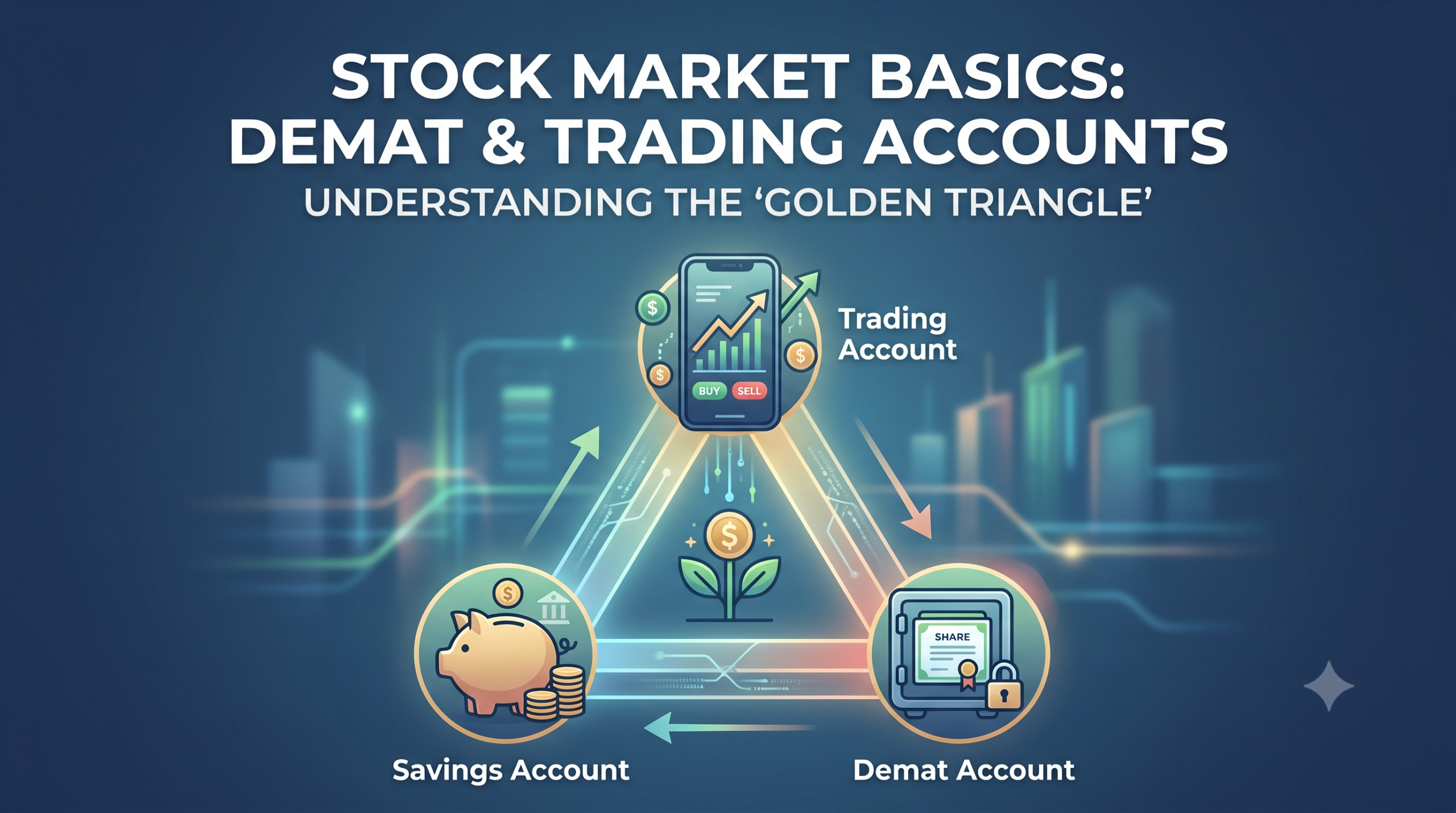
2. The Golden Triangle: How the 3 Accounts Work Together
You cannot just walk up to the National Stock Exchange (NSE) and hand them a ₹500 note for a share. You need a system. This system requires three separate accounts that talk to each other seamlessly. Let’s explain them like you are five years old.
1. The Savings Account (Your Wallet)
This is your normal, everyday bank account (like HDFC, SBI, or ICICI). This is where your salary arrives. It strictly holds Cash. It cannot hold shares.
2. The Trading Account (The Cashier)
This is the account you open with a Stockbroker (like Zerodha, Groww, or Upstox). It acts as the “middleman.” You use it to tell the stock exchange, “I want to buy 5 shares of this company right now.”
3. The Demat Account (The Vault)
Once the Trading Account buys the shares for you, they have to be stored somewhere safe. They are immediately dropped into your Demat Account. This account strictly holds Shares/Assets, it cannot hold cash.
🌍 Real-World Example: Rahul Buys His First Share
The Person: Rahul, age 24, a junior software engineer in Bengaluru.
The Goal: Rahul wants to buy 10 shares of Tata Motors. He downloads a brokerage app on his phone.
Step 1 (The Wallet): Using UPI, Rahul transfers ₹10,000 from his SBI Savings Account into his broker’s app.
Step 2 (The Cashier): He opens the app, searches for Tata Motors, and hits “Buy.” His Trading Account takes the cash, runs to the stock exchange, hands over the money, and grabs the 10 shares.
Step 3 (The Vault): Two days later, those 10 shares officially arrive and are permanently locked inside his Demat Account. The Golden Triangle is complete!
3. Who Actually Guards the Vault? (Understanding CDSL & NSDL)
Many beginners have a very common, very valid fear: “What happens if my broker (like Zerodha or Groww) goes bankrupt and shuts down? Will I lose all my shares?”
The answer is a massive, absolute NO.
Your stockbroker does not actually hold your shares. They are just the interface you use to buy them. Your shares are legally held by central government-registered “Depositories.” In India, there are two massive depositories that act as the ultimate guardians of the stock market:
- ✓ CDSL (Central Depository Services Limited)
- ✓ NSDL (National Securities Depository Limited)
Think of CDSL and NSDL as massive, ultra-secure central banks for shares. When you open a Demat account with a broker, the broker is simply creating a folder with your name on it inside the CDSL or NSDL servers.
🌍 Real-World Example: Anjali’s Broker Goes Bust
The Person: Anjali, age 30, a dentist in Pune.
The Crisis: Anjali used a small, unknown local broker to buy ₹5 Lakhs worth of shares over five years. One morning, she reads the news and sees that her broker has gone bankrupt due to mismanagement and their app has shut down completely. She panics, thinking her life savings are gone.
The Resolution: Anjali calls a financial advisor who calms her down. He explains that her broker was just a gateway. Her ₹5 Lakhs worth of shares are perfectly safe, sitting under her PAN card number in the CDSL vaults. All Anjali has to do is open a new trading account with a different, reliable broker, and link her existing CDSL Demat account to it. Her shares never moved.
4. Brokers & Hidden Charges: Don’t Get Cheated
To get this Golden Triangle working, you have to choose a broker. In India, there are two types of brokers, and they charge you very differently.
1. Full-Service Brokers
These are usually the big banks (like HDFC Securities, ICICI Direct, or Kotak Securities). They offer dedicated relationship managers, research reports, and stock tips. The Catch: They charge very high brokerage fees (sometimes a percentage of your trade, meaning if you buy ₹1 Lakh of shares, they might take ₹500 as a fee).
2. Discount Brokers
These are technology-first companies (like Zerodha, Groww, or Upstox). They give you a sleek app but no personalized advice. You are on your own to do research. The Benefit: They are incredibly cheap. Investing in stocks is usually completely free (₹0 brokerage), and intraday trading is capped at a flat ₹20 per trade.
The “Hidden” Charges You Must Know:
- → AMC (Annual Maintenance Charge): A yearly fee just to keep the Demat account open. Usually ₹200 to ₹500 a year.
- → DP Charges (Depository Participant Charge): This is the most misunderstood fee! Every single time you sell shares from your Demat account, CDSL/NSDL charges a flat fee of roughly ₹15 + GST. It doesn’t matter if you sell 1 share or 1,000 shares of a company, the flat fee applies.
🌍 Real-World Example: Karan Learns About DP Charges
The Person: Karan, age 22, a college student trying to make quick pocket money.
The Mistake: Karan bought 1 share of a company for ₹100. The next day, the share went up to ₹120. Excited that he made a ₹20 profit, he hit the “Sell” button. He did this with 10 different companies over a week, thinking he made ₹200 in pure profit.
The Reality: At the end of the month, he checked his statement. Every time he sold a company’s share, a flat DP charge of ₹15.93 was deducted. So, out of his ₹20 “profit” per trade, ₹15.93 went to the depository. He was left with pennies. He learned that because of flat DP charges, you should not frequently sell very tiny quantities of stocks from your Demat account.