
What is an FPO (Follow-on Public Offer) and How is it Different from an IPO?
You know what an IPO is, but suddenly the news is talking about a massive company launching an FPO. What does that mean? Why is a famous company asking for more money? Let’s break it down in plain, simple English.
1. The Bakery Expands Again: Understanding the FPO
To understand an FPO perfectly, let us bring back our famous bakery analogy.
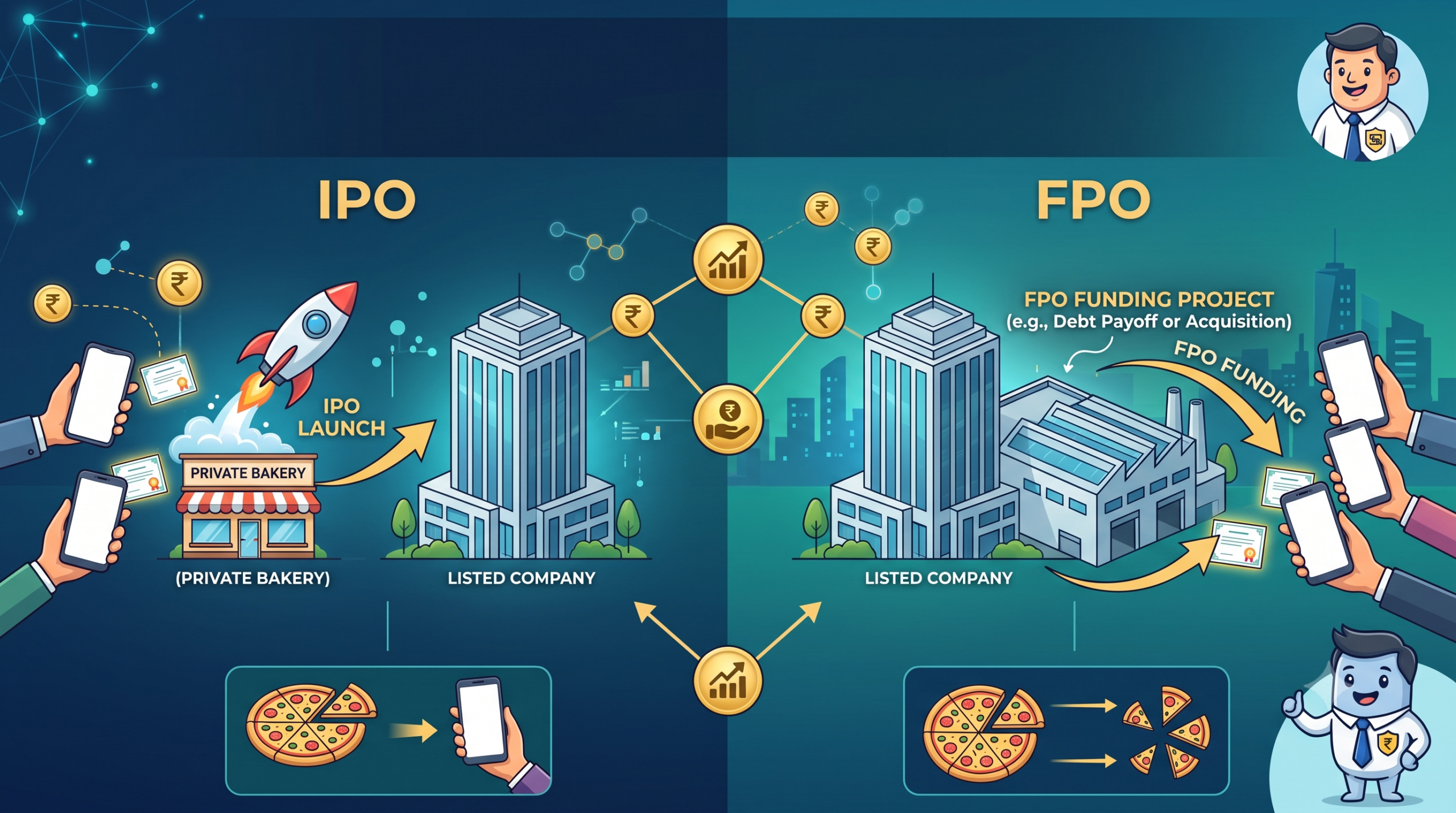
Remember Amit? He owned a successful private bakery. To expand and open 100 new stores, he did an IPO. He sold a portion of his company to the public. He got the money, the public got the shares, and the bakery was officially “listed” on the stock exchange. Everyone was happy.
Now, fast forward exactly five years.
Amit’s 100 stores are doing amazingly well. But Amit is ambitious. He now wants to build a giant, state-of-the-art chocolate factory to supply all his stores. Building this factory will cost him ₹500 Crores. Amit looks at his bank account and realizes he doesn’t have ₹500 Crores in cash.
Because his company is *already* listed on the stock market, he cannot do another IPO. Instead, he goes back to the stock market and announces: “Hello again, investors! We are doing great, but we want to build a mega-factory. We are going to issue a fresh batch of shares to raise more money.” This second, third, or fourth time a company asks the public for money is called a Follow-on Public Offer (FPO).
🌍 Real-World Example: Amit’s Bakery Timeline
The Year 2018 (The IPO): Amit’s Bakery is private. He launches an IPO. You buy shares for ₹100 each. The company uses this money to open 100 stores. Over the years, the business grows, and the share price on your stock app rises to ₹300.
The Year 2024 (The FPO): Amit wants to build the mega-factory. He launches an FPO. Since the current share price on the market is ₹300, he offers this *new* batch of shares to the public at ₹280 (giving a small discount to attract buyers).
The Result: You, as an existing shareholder, can buy more shares at the ₹280 discount, or new investors who missed the IPO in 2018 can finally jump in. Amit gets his ₹500 Crores, and the factory is built!
2. IPO vs. FPO: The Head-to-Head Differences
While they sound similar, IPOs and FPOs are completely different beasts when it comes to risk, pricing, and investor behavior. Here is how they compare:
IPO (Initial Public Offering)
- → Status: The company is unlisted and private.
- → Risk Level: Very High. You have no past stock market data to analyze. You are relying entirely on their self-reported prospectus.
- → Pricing: The company and their bankers decide the price. It might be overpriced.
- → Objective: To enter the stock market and raise initial growth capital.
FPO (Follow-on Public Offer)
- → Status: The company is already listed and publicly traded.
- → Risk Level: Moderate to Low. You can see years of their stock market history, how they handle crises, and read thousands of public analyst reports.
- → Pricing: Driven by the current stock market price. (Usually offered at a slight discount).
- → Objective: To raise *additional* funds for debt clearance or major expansions.
3. Why Do Companies Need an FPO?
If a company is already listed and making profits, why do they need to come begging the public for more money? There are three main reasons, and as an investor, you must figure out *which* reason they are using before you invest your hard-earned money.
- 1. To Pay Off Crushing Debt: Many infrastructure or telecom companies take massive bank loans. When the interest payments become too heavy, they issue an FPO to get cash from the public to pay off the bank. (This makes the company safer long-term).
- 2. To Buy Another Company: Sometimes a company wants to buy their biggest competitor, but they don’t have the ₹2,000 Crores needed. They use an FPO to raise the cash for the acquisition.
- 3. SEBI Rules: In India, the market regulator (SEBI) states that a listed company must have at least 25% of its shares owned by the general public. If the founders own 90%, they are forced to launch an FPO to sell 15% to the public to follow the rules.
🌍 Real-World Example: Anil’s Bank Crisis
The Situation: Consider a famous Indian bank (let’s call it ABC Bank) that gave out too many bad loans. The bank was running out of cash to give back to its depositors, and the RBI had to step in.
The Action: To survive, ABC Bank desperately needed ₹15,000 Crores of fresh capital. They announced a massive FPO. Because the bank was in trouble, they priced the FPO at a huge discount to attract brave investors.
The Result: Retail investors like Anil bought the FPO shares at ₹12. With the massive influx of ₹15,000 Crores from the public, the bank cleared its toxic debts, survived the crisis, and eventually stabilized. Over a few years, Anil’s ₹12 shares grew back to a healthy ₹25. The FPO literally saved the company from bankruptcy.
4. The Pizza Problem: Dilutive vs. Non-Dilutive FPOs
This is the most crucial concept to understand before you invest in an FPO. Financial experts use the terrifying word “Share Dilution.” Let’s make it incredibly simple using a Pizza.
Scenario A: The Dilutive FPO (New Slices)
Imagine a company is a large Pizza cut into 4 huge slices. You own 1 slice, meaning you own 25% of the company. Now, the company wants more money (an FPO), so they create new shares. They cut the same pizza into 8 smaller slices to sell to new people.
You still own 1 slice, but because the pizza was cut into 8 pieces, your 1 slice now represents only 12.5% of the company instead of 25%. Your ownership has been “diluted” (made smaller). This is why, when a Dilutive FPO is announced, the company’s share price on the stock market usually drops immediately, because every existing share just became slightly less valuable.
Scenario B: The Non-Dilutive FPO (No New Slices)
In this scenario, the company does *not* create new shares. Instead, the founders (Promoters) who own a lot of shares decide to sell their *own personal shares* to the public. The total number of slices stays exactly the same. No one’s ownership gets diluted. The money from this FPO goes directly into the founders’ pockets, not to the company’s bank account.
🌍 Real-World Example: Rakesh and the Share Price Drop
The Person: Rakesh, an investor who owns shares of a popular Indian infrastructure company.
The Before: Rakesh bought shares at ₹1,000 each. The company was doing well. Suddenly, the company announced a massive ₹20,000 Crore Dilutive FPO to fund a new green energy project by creating 20 Crore brand-new shares.
The Crisis: The next morning, the stock market opened, and Rakesh saw his shares drop from ₹1,000 to ₹850 in a single day. He panicked.
The Lesson: Rakesh didn’t understand dilution. Because the company printed millions of new shares, the “pizza slices” got smaller, and the market adjusted the price downward. However, two years later, when the green energy project started making huge profits with the FPO money, the share price crossed ₹1,500. Dilution hurts short-term, but can create massive wealth long-term if the money is used correctly.
5. Should You Invest? The Discount Advantage
If a company’s shares are already trading on your Zerodha or Groww app, why on earth would you go through the long process of applying for their FPO? Why not just hit “Buy” on the app right now?
The answer is one magic word: Discount.
Companies know that if they price the FPO exactly the same as the current market price, nobody will bother applying. To encourage retail investors to give them massive amounts of cash, they offer the FPO shares at a 5% to 15% discount compared to the live stock market price.
🌍 Real-World Example: Sunita’s Smart Discount
The Person: Sunita, age 40, a homemaker and active investor from Chennai.
The Before: A major Indian telecom company was trading on the live market at ₹150 per share. The company announced an FPO to roll out its new 5G network. To attract buyers, they priced the FPO lot at ₹130 per share.
The Action: Sunita loved the company but felt ₹150 was too expensive. When she saw the FPO priced at ₹130, she instantly applied for ₹1,30,000 worth of shares (1,000 shares) and was allotted the lot.
The After: When the FPO shares were credited to her Demat account a week later, the live market price of the stock had slightly adjusted to ₹145. Even so, because Sunita bought them at ₹130, she was instantly sitting on a profit of ₹15 per share (a ₹15,000 total gain) without doing anything. She took advantage of the built-in FPO discount.